





Key Takeaways: Standard corporate tops often restrict upper arm mobility due to poor armhole grading. An overlapping tulip sleeve solves this mechanical flaw by providing dynamic movement without sacrificing professional coverage. A structured peplum waist eliminates midday stomach restriction, though highly traditional sectors still demand rigid button-down cuffs for major presentations.
Last month, a senior public relations director based in Mumbai visited our studio completely exasperated. Her complaint was entirely focused on her upper arms. Every time she bought a standard formal top for women, the armholes were cut so high and narrow that she could not comfortably type at her keyboard. Worse, the tight sleeves trapped heat during her humid morning commute, leaving her feeling sweaty and restricted before her first meeting even started.
This physical restriction is a massive flaw in standard Western pattern grading. The NIFT INDIA size data highlights that Indian body proportions require different armhole depth and upper bicep width. When fast fashion brands simply scale up their basic templates, they ignore this critical three-dimensional volume.
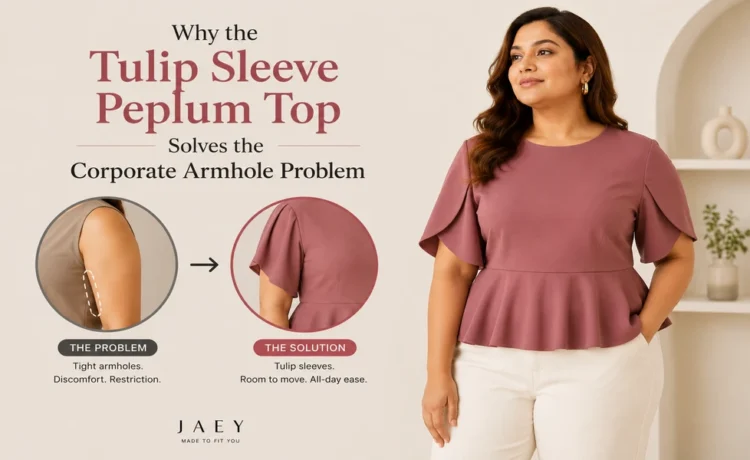
Shifting to a tulip sleeve top completely removes this mechanical trap. The sleeve consists of two overlapping panels of fabric that open and close dynamically as you move your arm. You get the professional shoulder coverage of a standard short sleeve with the absolute, unrestricted mobility of a sleeveless cut. There is no pulling across the back and no fabric digging into your underarm when you reach across a conference table.
Pair this specific sleeve architecture with a structured peplum waist, and you solve the afternoon comfort crisis entirely. The top anchors securely at the narrowest part of your torso and then gently flares outward, floating over your stomach rather than clinging to it. To make this structure hold its shape under a freezing centralized office AC, the fabric weight has to be precise. A medium-weight poly-crepe blend works flawlessly. The synthetic base holds the architectural flare of the peplum, while the breathable weave survives a sticky transit.
When a Traditional Formal Shirt is Still the Better Choice
We must acknowledge that a tulip sleeve peplum does not align with every single legacy dress code. If you are an executive presenting to an orthodox venture capital board or a litigator appearing in a high court, the visual rules remain stubbornly rigid. Those deeply conservative spaces expect the sharp, stiff collar and buttoned cuffs of a traditional tailored shirt. In those rare, highly formal rooms, a flared sleeve is often perceived as too relaxed. You simply have to sacrifice physical comfort to project a specific, old-world authority. But for modern tech parks, media agencies, and everyday desk work, dynamic tailoring is infinitely more practical.
Frequently Asked Questions
How do you style a peplum top for the office? Because the peplum flares at the bottom, you must keep your lower half completely streamlined. Pair it with a highly structured pencil skirt or a pair of slim, straight-leg formal trousers to maintain a balanced corporate silhouette. Avoid wide-leg pants, which create too much overall volume.
Do tulip sleeves flatter broad shoulders? Yes, they actually soften the shoulder line. The overlapping diagonal cut breaks up the visual width of the upper arm, drawing the eye downward rather than straight across.
How should I wash a structured peplum top? Never put architectural garments in a hot tumble dryer. The extreme heat degrades the fibers holding the peplum flare. Machine wash inside out on a cold, gentle cycle and air dry on a hanger in the shade to maintain the crisp lines.