





Sometimes you try a product, and you just know it’s not right.
Maybe it feels too sticky, too heavy, or just like it’s doing nothing at all. And you stand there wondering if you applied it wrong. Well, honestly, most of the time, it’s not your technique. It’s just that the formula doesn’t suit your hair.
You see, the simple fact is hair texture products don’t behave the same way on everyone! A cream that defines someone else’s curls might flatten your waves. Similarly, a volumizing spray that lifts fine hair might barely make a difference on thick strands. Here’s how to go about it.
Step 1: Decide Based on Strand Thickness
Before getting into styling goals, pay attention to the strands themselves. Not the volume or the cut. Just the thickness of a single strand. That detail changes how products behave.
For example, if your strands are fine, you have probably noticed that heavier creams don’t really blend in. They sit there. At first, it looks smooth, then a few hours later, the hair feels flat. In that case, lighter textures usually make more sense. Sprays, soft mousses, or thinner serums tend to give shape without pressing everything down.
Whereas the medium strands are less dramatic. They don’t collapse easily, but they don’t fight back either. Most light creams or gels work without making the hair feel stiff.
Thicker strands are another story. Very light formulas often disappear without doing much. The hair may still feel dry or undefined. Richer creams or oil-based stylers usually have enough weight to actually make an impact.
A quick way to check yourself: if your hair feels heavy soon after styling, you probably went too rich. If it still feels rough, you likely need something more substantial.
Step 2: Choose According to Hair Pattern
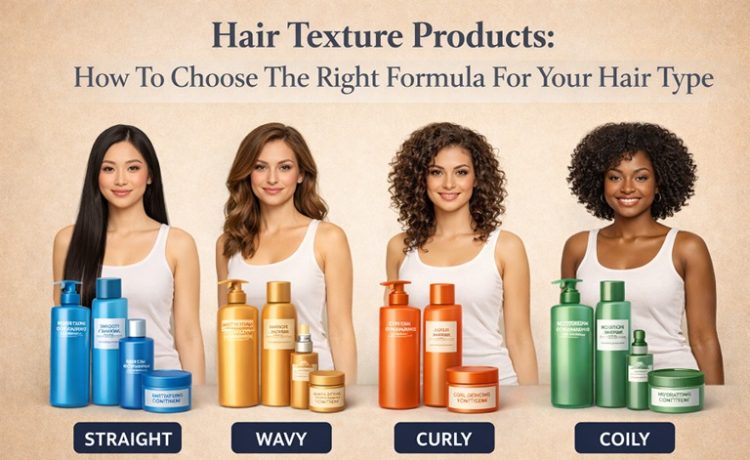
Once you have figured out the thickness, the next thing to look at is your natural pattern. You see, straight, wavy, curly, and coily all these hair types don’t react the same way to the product.
- Straight hair usually doesn’t need more moisture. It needs something that gives it grip so it doesn’t fall flat. That’s why texturizing sprays, light clays, or flexible mousses tend to work better. Heavy oils often just sit there and make the roots look oily faster than you’d like.
- Waves are a little more tricky. Too much product and they lose shape. Whereas too little and they look undefined. Lightweight creams or soft gels usually help bring out the pattern without making it stiff.
- Curly hair normally needs both moisture and hold at the same time. A cream alone can feel too soft, and a gel alone can feel too stiff. However, used together, they usually balance each other out and keep curls grouped instead of frizzy.
Moreover, hair texture products are designed with these patterns in mind, but even here, formula weight still matters just as much as curl shape.
Step 3: Pay Attention to Moisture Retention
Now, this one is easy. You don’t need a test kit to understand this.
All you need to do is just watch how your hair behaves after washing it.
- If it dries really fast, it probably loses moisture just as quickly. In that case, slightly richer formulas tend to keep it feeling softer for longer.
- However, if it takes a long time to dry, layering heavy products can lead to buildup. Lighter hair texture products often feel more balanced in that situation.
It’s less about theory and more about paying attention.
Step 4: Match Product Type to Purpose
See, this is no secret that not every product does the same job, even if they all sit on the same shelf. You will find that:
- Sprays usually add lift or a bit of texture.
- Mousses give flexible volume without stiffness.
- Creams add moisture and some control.
- Gels bring a stronger hold and definition.
- Oils help seal and soften.
- Clays and pomades create grip and structure.
Now, knowing this makes choosing hair texture products less random. And if you want to compare formulas more clearly before buying, browsing options, some genuine and best hair texture products can help you see how different types are grouped based on texture needs.
Step 5: Apply Strategically
Even a good product can feel wrong if it’s applied everywhere the same way! Honestly, application matters way more than you think.
So, if your scalp gets oily but your ends feel dry, don’t put heavy products at the roots. Focus on richer formulas where the hair actually needs it. Start with lighter products. Add heavier ones only if necessary. When you layer in that order, products tend to absorb better and feel less heavy.
Final Thoughts
In the end, just remember that choosing hair texture products doesn’t have to feel complicated. When you understand your strand thickness, pattern, and how your hair handles moisture, the decisions get clearer.
So, instead of switching products constantly, start building a routine that actually suits your hair, and that’s when styling becomes more consistent.